Microbiomes of Aerobic Wasterwater Treatment
Cover Image from: Wastewater Treatment Plants Could Become Sustainable Biorefineries. (2019). In Treatment Plant Operator. Retrieved from https://www.tpomag.com/online_exclusives/2019/01/wastewater-treatment-plants-could-become-sustainable-biorefineries
Home
Click to open related pages:
Background Information for Aerobic Wastewater Treatment
Why Treat Wastewater?
Treatment of wastewater is essential as when water with high amounts of chemicals such as ammmonium (and other nitrogen containing molecules), phosphorus, organic metals and other contaminants, are discharged into waterways, eutrophication occurs. Eutrophication is excessive growth of algae and cyanobacteria which typically deprives the waterway of oxygen which is a major issue for aquatic life. Therefore, it is important to reduce the amount of these chemicals before discharging wastewater into rivers or oceans.
Aerobic Digestion
The first process of aerobic digestion of waste is biomass destruction. This occurs when microorganisms are deprived of their food source so that they digest their own protoplasm for energy. This process requires oxygen and the input of organic products, and produces carbon dioxide, water and ammonium bicarbonate. The released ammonia must be reduced as it causes odor and other issues.
Ammonia is reduced by the process of nitrification occurs with the presence of nitrifying bacteria. In this process, ammonia is oxidised in the presence of oxygen and the products released are water and nitric acid, which decreases the pH and is toxic to many microbes. Thus, nitric acid must be removed by a process of denitrification.
Denitrification is an anaerobic process assisted by denitrifying bacteria. In this process, nitrate from nitric acid is reduced to ammonia, bicarbonate and gaseous nitrogen. As bicarbonate is produced, the pH of the solution that the bacteria are in will begin to neutralise.
Phosphorus Removal
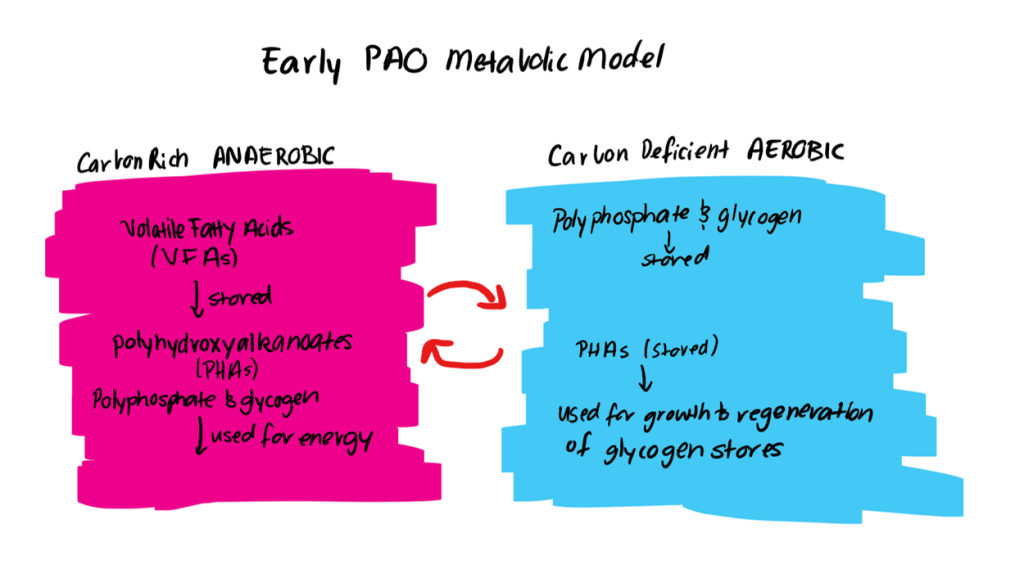
Another process important to wastewater treatment is removal of phosphorus. The process that achieves this is called Enhanced Biological Removal of Phosphorus (or EBPR). EBPR is achieved by the presence of polyphosphate accumulating organisms (PAOs) and is a great method to use in wastewater treatment as it does not require the addition of chemicals, therefore it is sustainable, effective and especially economical as the accumulated phosphorus can be sold and used in fertiliser. PAOs essentially have diverse ways of using aerobically stored polyphosphate to provide energy for anaerobic carbon uptake, which is shown in the diagram below.
The main method of wastewater treatment discussed on this blog is activated sludge. This is a method in which bacterial colonies are suspended in an aeration treatment tank. The bacterial colonies decompose organic compounds into settleable solids. This mixture is usually sent to a secondary clarifier where the sludge settles at the bottom. The settled sludge can usually be sent back to the primary aeration tank to be reused around two or three times and then sent to the sludge digester.
Useful Videos
About the Author
Madison Billings is a second year student at Melbourne University studying Environmental Engineering with an interest in Wastewater Treatment and Renewable Resources.
Get new content delivered directly to your inbox.
 Microbiomes in Aerobic Watewater Treatment